Deploy a React App
React, also known as React.js or ReactJS, is a popular JavaScript library developed by Meta for building user interfaces, especially for web and native applications.
React simplifies the process of creating interactive and dynamic UIs by breaking them down into reusable components.
This guide covers how to deploy a React app to Railway in four ways:
Now, let's create a React app!
Create a React app
Note: If you already have a React app locally or on GitHub, you can skip this step and go straight to the Deploy React App on Railway.
To create a new React app, ensure that you have Node installed on your machine.
Run the following command in your terminal to create a new React app using Vite:
npm create vite@latest helloworld -- --template reactA new React app will be provisioned for you in the helloworld directory.
Run the React app locally
Next, cd into the directory and install the dependencies.
npm installStart the Vite development server by running the following command:
npm run devOpen your browser and go to http://localhost:5173 to see your app.
Deploy the React app to Railway
Railway offers multiple ways to deploy your React app, depending on your setup and preference.
One-click deploy from a template
If you’re looking for the fastest way to get started, the one-click deploy option is ideal. It sets up a React app with Caddy to serve the dist folder.
Click the button below to begin:

It is highly recommended that you eject from the template after deployment to create a copy of the repo on your GitHub account.
Note: You can also choose from a variety of React app templates created by the community.
Deploy from the CLI
- Install the Railway CLI:
- Install the CLI and authenticate it using your Railway account.
- Initialize a Railway Project:
- Run the command below in your React app directory.
railway init - Follow the prompts to name your project.
- After the project is created, click the provided link to view it in your browser.
- Run the command below in your React app directory.
- Deploy the Application:
- Use the command below to deploy your app:
railway up - This command will scan, compress and upload your app's files to Railway. You’ll see real-time deployment logs in your terminal.
- Once the deployment completes, go to View logs to check if the service is running successfully.
- Use the command below to deploy your app:
- Set Up a Public URL:
- Navigate to the Networking section under the Settings tab of your new service.
- Click Generate Domain to create a public URL for your app.
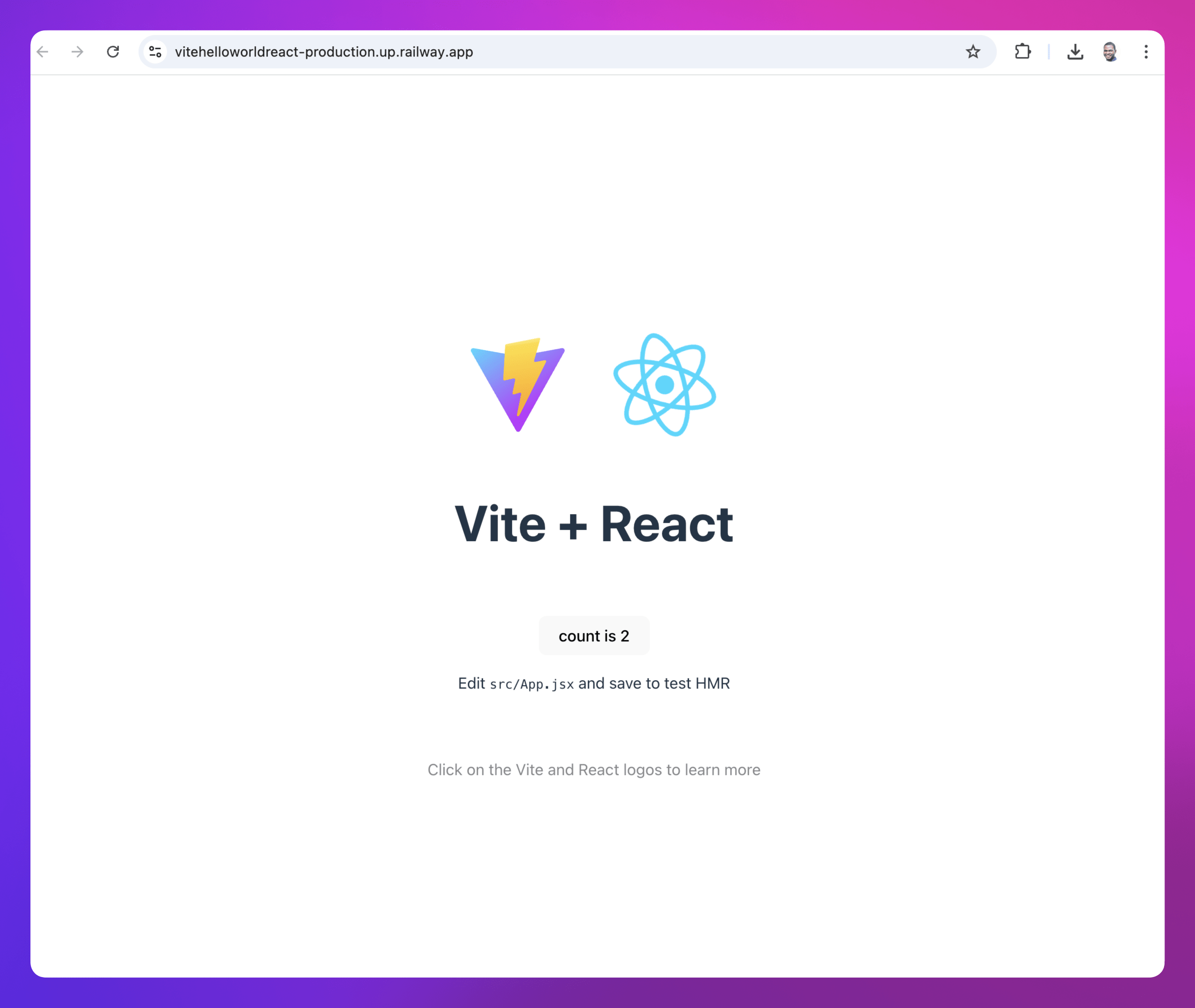
Deploy from a GitHub repo
To deploy a React app to Railway directly from GitHub, follow the steps below:
- Create a New Project on Railway:
- Go to Railway to create a new project.
- Deploy from GitHub:
- Select Deploy from GitHub repo and choose your repository.
- If your Railway account isn’t linked to GitHub yet, you’ll be prompted to do so.
- Select Deploy from GitHub repo and choose your repository.
- Deploy the App:
- Click Deploy to start the deployment process.
- Once the deployed, a Railway service will be created for your app, but it won’t be publicly accessible by default.
- Verify the Deployment:
- Once the deployment completes, go to View logs to check if the server is running successfully.
- Set Up a Public URL:
- Navigate to the Networking section under the Settings tab of your new service.
- Click Generate Domain to create a public URL for your app.
Use a Dockerfile
-
Create a
Dockerfilein thehelloworldor React app's root directory. -
Add the content below to the
Dockerfile:# Use the Node alpine official image # https://hub.docker.com/_/node FROM node:lts-alpine AS build # Set config ENV NPM_CONFIG_UPDATE_NOTIFIER=false ENV NPM_CONFIG_FUND=false # Create and change to the app directory. WORKDIR /app # Copy the files to the container image COPY package*.json ./ # Install packages RUN npm ci # Copy local code to the container image. COPY . ./ # Build the app. RUN npm run build # Use the Caddy image FROM caddy # Create and change to the app directory. WORKDIR /app # Copy Caddyfile to the container image. COPY Caddyfile ./ # Copy local code to the container image. RUN caddy fmt Caddyfile --overwrite # Copy files to the container image. COPY --from=build /app/dist ./dist # Use Caddy to run/serve the app CMD ["caddy", "run", "--config", "Caddyfile", "--adapter", "caddyfile"]The
Dockerfilewill use Caddy to serve the React app. -
Add a
Caddyfileto the app's root directory:# global options { admin off # there's no need for the admin api in railway's environment persist_config off # storage isn't persistent anyway auto_https off # railway handles https for us, this would cause issues if left enabled # runtime logs log { format json # set runtime log format to json mode } # server options servers { trusted_proxies static 0.0.0.0/0 ::/0 } } # site block, listens on the $PORT environment variable, automatically assigned by railway :{$PORT:3000} { # access logs log { format json # set access log format to json mode } # health check for railway rewrite /health /* # serve from the 'dist' folder (Vite builds into the 'dist' folder) root * dist # enable gzipping responses encode gzip # serve files from 'dist' file_server # if path doesn't exist, redirect it to 'index.html' for client side routing try_files {path} /index.html } -
Either deploy via the CLI or from GitHub.
Railway automatically detects the Dockerfile, and uses it to build and deploy the app.
Note: Railway supports also deployment from public and private Docker images.
This guide covers the main deployment options on Railway. Choose the approach that suits your setup, and start deploying your React apps seamlessly!
Next steps
Explore these resources to learn how you can maximize your experience with Railway:
- Configure SPA routing - Set up Caddy fallback for client-side routing.
- Manage environment variables - Handle
VITE_prefixed variables. - Add a Database Service
- Monitor your app