Railway vs Lovable: Technical Comparison and Migration Guide
Last updated: June 2026
Lovable and Railway are both fantastic products, and they share some similarities: both can deploy a web application to the internet, connect to a database to store your data, handle environment variables and configuration, and set up a custom domain. But they're ultimately different tools for solving different problems.
Lovable is built to take you from zero to one. You describe what you want, and it writes the code and hosts the result. The value is in the high-quality code that Lovable generates from human language. Railway takes over from there: you bring the code, and Railway handles everything you need to run and scale that application reliably as it grows, including packaging, infrastructure, deployment, and observability.
In this piece, we'll go a bit deeper on what each platform does best.
Application code generation
Lovable
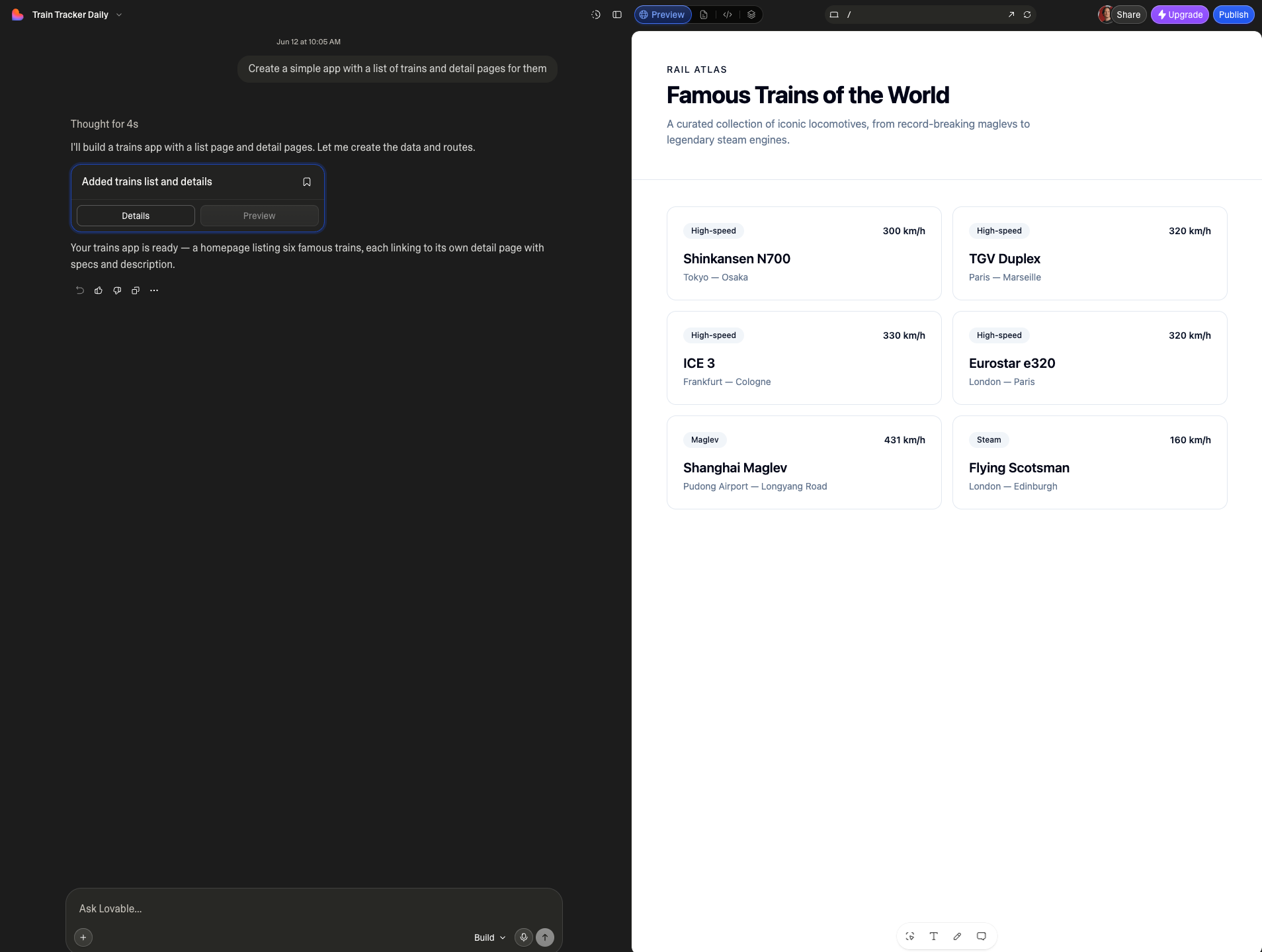
Lovable generates application code from natural language prompts. You describe a feature, a screen, or even a whole product, and Lovable builds it. This makes it an excellent choice to go from an idea to something working.
Railway
Railway comes with a coding agent that can help with project and service configurations, debugging, and some lighter-weight coding tasks.
Deployment and hosting
Once your app is written, the code needs to be packaged, deployed to the cloud, and made available to users at a URL.
Lovable
Hosting is included in Lovable as part of the core product experience. For getting something live quickly, it works great, but there is limited control over performance issues, and rollbacks are code-only. You can't control the underlying deployment environment. This is generally fine for prototypes, but when you have real users who expect things to work across updates, it can become a significant drawback.
Railway
Railway gives you full control over how your application is deployed and served, which is important as you scale. As new code goes out, health checks verify that deployments are actually working before they receive traffic. Your app stays up during updates thanks to Railway's rolling updates, and if something does go wrong, rollbacks let you get back to a known good state in seconds with no data loss.

Databases
A database is where your application stores and retrieves data: user accounts, posts, orders, anything that needs to persist between sessions.
Lovable
Lovable includes a built-in backend option called Lovable Cloud, which handles your database, authentication, and file storage without leaving the platform. You can also connect an external Supabase account if you want more control, but that means another login, another vendor to pay as you scale, and another place to look when something breaks.
Railway
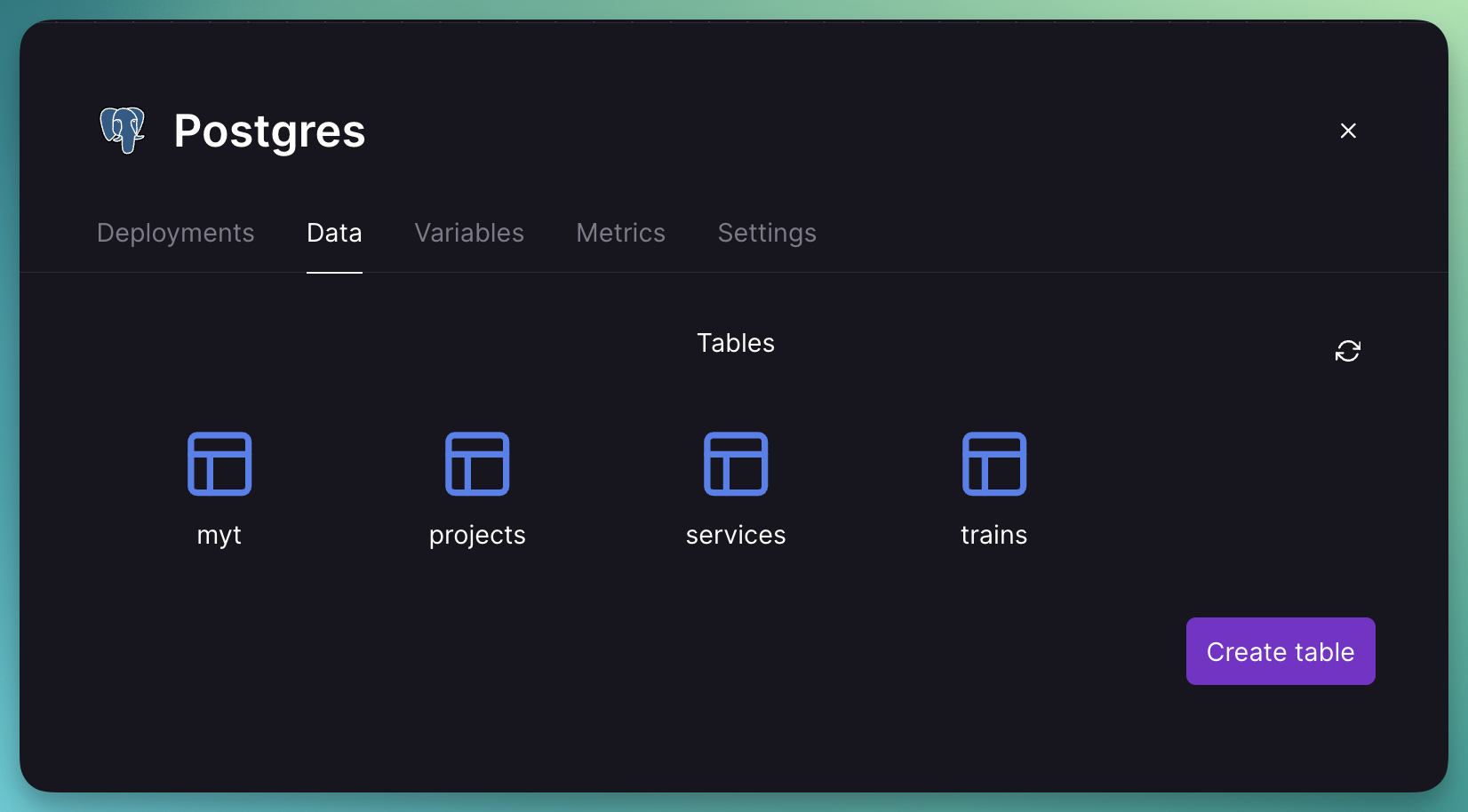
Railway includes multiple native database options depending on the needs of your application, including PostgreSQL, MySQL, Redis, and MongoDB. You can add one to your project in a few clicks, and it will live on the same private network as your application, with backups you can schedule and a query view in the dashboard so you can browse your data without leaving Railway.
Scaling
As demand on your application grows, either because of more users, sales, or anything else your app does, the infrastructure behind it needs to grow in size to accommodate the higher traffic.
Lovable
Lovable deploys a single application. There's no visibility into how it is performing under load, and no way to scale it as your user base grows and demands higher throughput or more compute power.
Railway
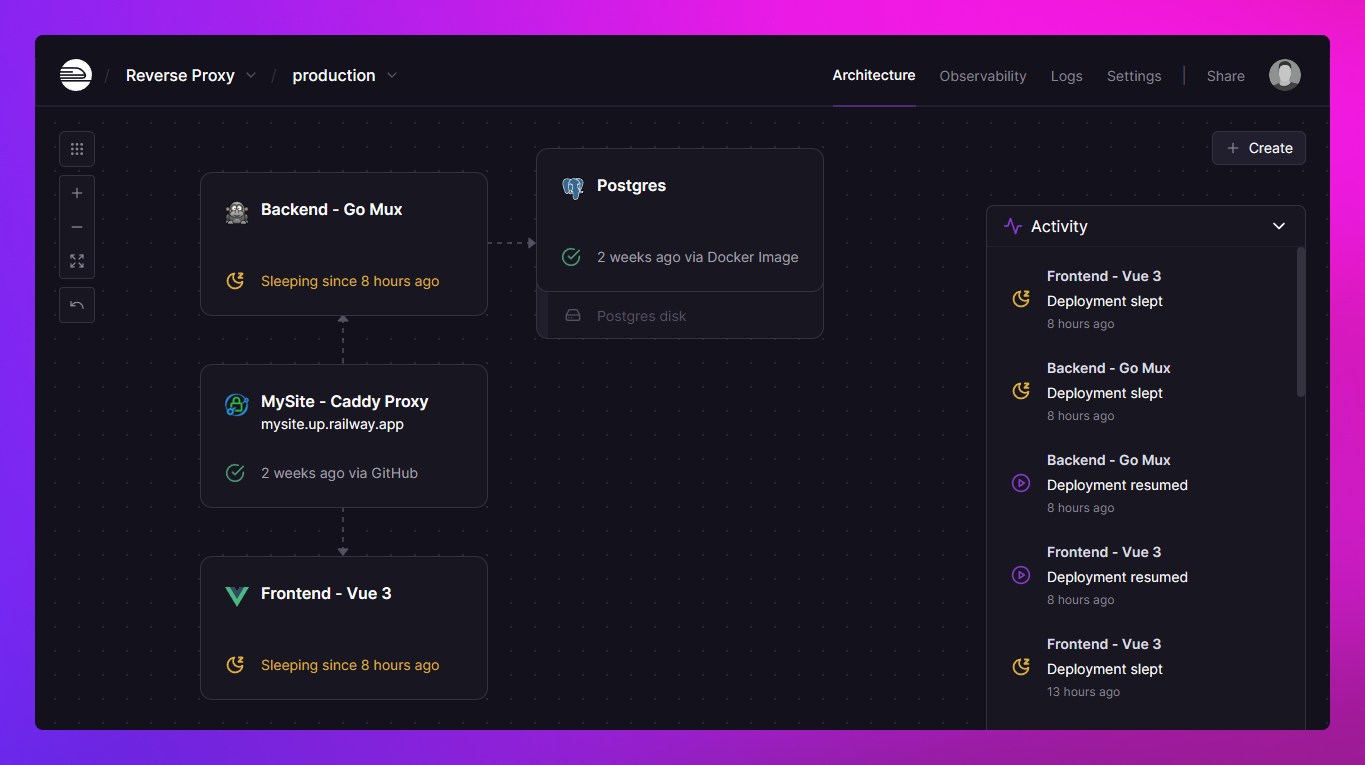
Railway lets you scale vertically by giving a service more CPU or memory, and horizontally by running multiple copies of it simultaneously. When traffic spikes, Railway distributes requests across those copies automatically. A project can contain multiple services, each independently scalable: a frontend, an API, a background worker, a database. They communicate over private networking, so they stay fast and isolated from the public internet.
Observability and debugging
Observability means being able to see what is happening inside your running application. Without it, you only find out something is broken when a user tells you.
Lovable
Lovable offers limited visibility into running applications, with no full logs or metrics. If something breaks or slows down in production, there's little to help you see what happened or when.
Railway
Railway includes logs, metrics, and a full deployment history. You can see every request, every error, and CPU and memory usage over time. When something goes wrong, you can trace it back to a specific deploy and roll it back.

Pricing
Lovable
Lovable uses subscription tiers based on the number of prompts and the features included in your plan. This works well if you're building at a steady pace, but unused prompts don't roll over, so a slow month means you're just paying for nothing.
Railway
Railway uses usage-based pricing, which means you only pay for active compute time and the resources your services consume. This works well for real apps with real usage patterns, as costs scale with your app's traffic.
Using Lovable and Railway together
Lovable and Railway work well as a team. You can build and iterate in Lovable, push the code to GitHub, and deploy on Railway for production hosting.
Once that connection is in place, every push Lovable makes to your GitHub repo triggers a new deploy on Railway automatically. You get the speed of AI-assisted development with the reliability of production-grade infrastructure underneath it.
See Deploy a Lovable App on Railway to get started.
Summary
| Category | Lovable | Railway |
|---|---|---|
| Primary purpose | AI code generation from natural language prompts | Cloud hosting and infrastructure for your code |
| Code source | Generated by the platform | Bring your own (GitHub, CLI, Docker) |
| Infrastructure control | Minimal; managed by the platform | Full control over runtime, networking, scaling, and deployment |
| Multi-service support | Single application only | Multiple services, workers, cron jobs in one project |
| Database support | Built-in (Lovable Cloud) or external Supabase | Managed PostgreSQL, MySQL, Redis, MongoDB with backups and database views |
| Observability | Limited | Logs, metrics, and deployment history |
| Zero-downtime deploys | No | Yes |
| Rollbacks | No | Yes |
| Health checks | No | Yes |
| Custom domains with TLS | Limited | Fully managed, including wildcard domains |
| Pricing model | Subscription-based (per plan) | Usage-based (pay for compute time and resources consumed) |
| Best for | Generating and prototyping apps with AI | Production hosting with full infrastructure control |
Migration path
If you're ready to move your Lovable app to Railway, just connect your GitHub repo, import your environment variables, and configure your domain. See Migrate from Lovable to Railway for a step-by-step guide.
Need help or have questions?
If you need help along the way, the Help Station is a great resource to get support from the team and community.
Working with a larger workload or have specific requirements? Book a call with the Railway team to explore how we can best support your project.