MySQL High Availability
Railway can convert an existing MySQL service into a managed high-availability cluster backed by MySQL Group Replication and HAProxy. The data nodes form a single-primary Group Replication group — consensus runs inside MySQL itself, so there is no separate coordinator tier — and HAProxy routes client connections to whichever node is currently the primary. If the primary goes down, the group elects a new one and HAProxy begins routing to it within seconds.
Converting to high availability is what makes this a managed database in the sense what Railway manages describes: Railway provisions the cluster and ships security patches for its image, and failover happens automatically inside the cluster. The cluster overview shows each node's role and health; alerting on it is yours to set up, and Railway does not publish an uptime SLA today. Schema, queries and data stay yours.
How the cluster is shaped
A converted cluster consists of:
- MySQL data nodes — your original service becomes the primary, plus an even number of replicas, for an odd cluster total (3, 5, 7, or 9). Group Replication needs a strict majority of members to agree before electing a primary, and an odd count is what lets the group reach that majority during a network partition instead of splitting the vote. Secondaries run with
super_read_onlyenabled at all times, so writes can never land outside the group's certification. - HAProxy — the single entry point for clients. It probes every data node's role endpoint and routes connections to the current primary, so your application never needs to know which node holds that role.
There is no read endpoint over the secondaries in this version — all connections, reads included, go to the primary through HAProxy. The replicas exist for failover, not read scaling.
Prerequisites
Before converting, confirm the following:
Official MySQL image — Only services running the official mysql Docker image (what Railway's MySQL template deploys) are supported, along with services already on Railway's cluster data-node image (ghcr.io/railwayapp-templates/mysql-ha/mysql) but running standalone. Forks and variants (e.g. MariaDB, Percona) are not compatible. If your service qualifies, the High Availability section appears in its Config tab.
Supported version — The image must be tagged with a supported major version: 8 or 9. The :latest tag and named tags are not supported — Railway needs a detectable version to pin the cluster's images to. If your service uses :latest, change the image to a versioned tag (e.g. mysql:8.4) in the service settings and redeploy before converting.
As part of the conversion, Railway pins the data nodes to your service's exact major.minor series. The cluster image is only published at exact minor tags (8.4, 9.4, and so on), never a bare major, so pinning to the version already running is what makes a real image available to pull.
No custom start command — The cluster image manages its own startup, so a service with a customer-set start command can't be converted. If your service has one, the High Availability section shows a warning with a one-click Reset to template default button — MySQL reads its credentials from environment variables (MYSQL_ROOT_PASSWORD), not from the start command, so resetting never affects authentication.
Step 1 — Open the High Availability section
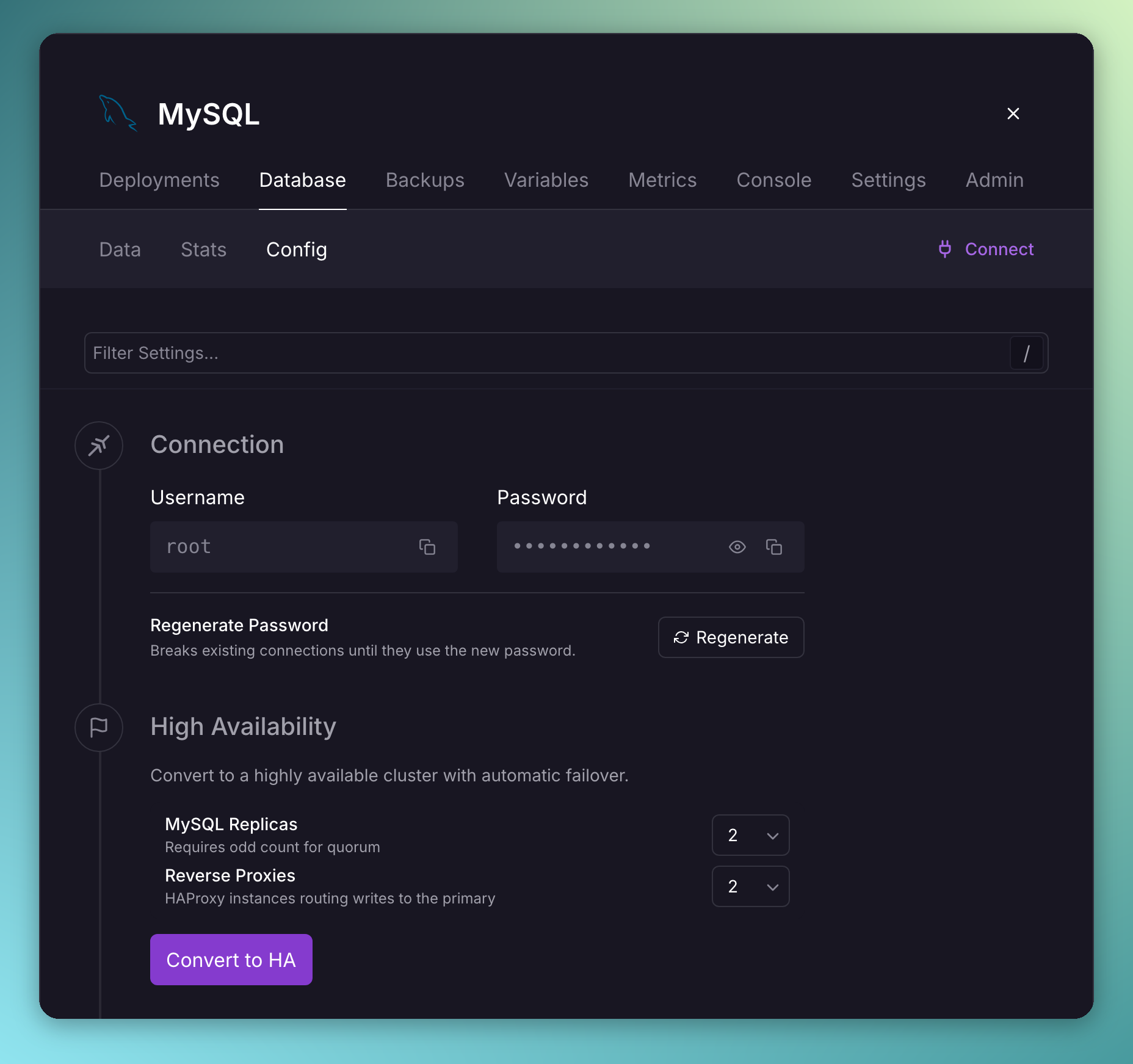
Open your MySQL service and navigate to Database → Config → High Availability.
Step 2 — Configure and Convert
You will see options to configure the cluster size before converting:
| Setting | Default | Description |
|---|---|---|
| MySQL Replicas | 2 | Replicas added to the primary. Options: 2, 4, 6, or 8 — even counts keep the cluster's total node count odd: 3, 5, 7, or 9 nodes. |
| Reverse Proxies | 2 | HAProxy instances routing connections to the primary. Options: 1 or 2. Trial workspaces are limited to 1. |
There is no separate coordinator tier to size — Group Replication's consensus runs inside the MySQL nodes themselves.
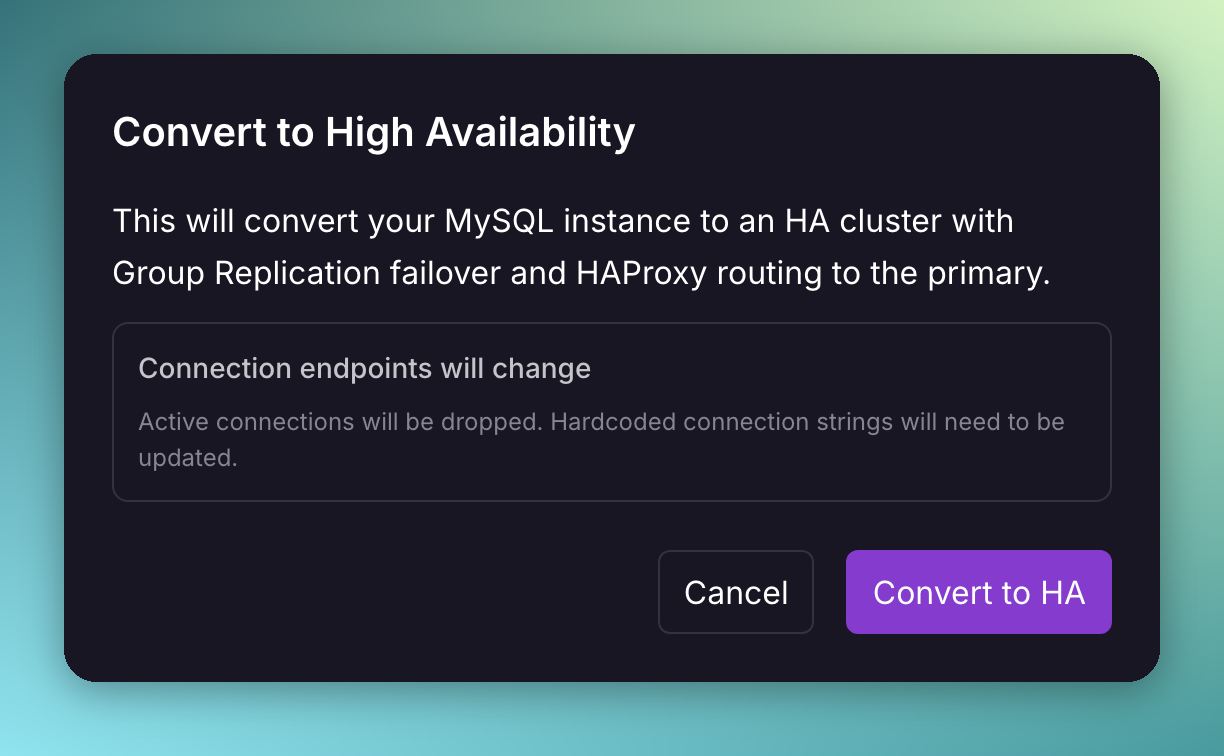
Click Convert to HA. A confirmation dialog will appear warning that:
- Active connections will be dropped during the conversion
- Connection endpoints will change — any hardcoded connection strings will need to be updated after conversion
After confirming, Railway will:
- Create a backup of your database volume
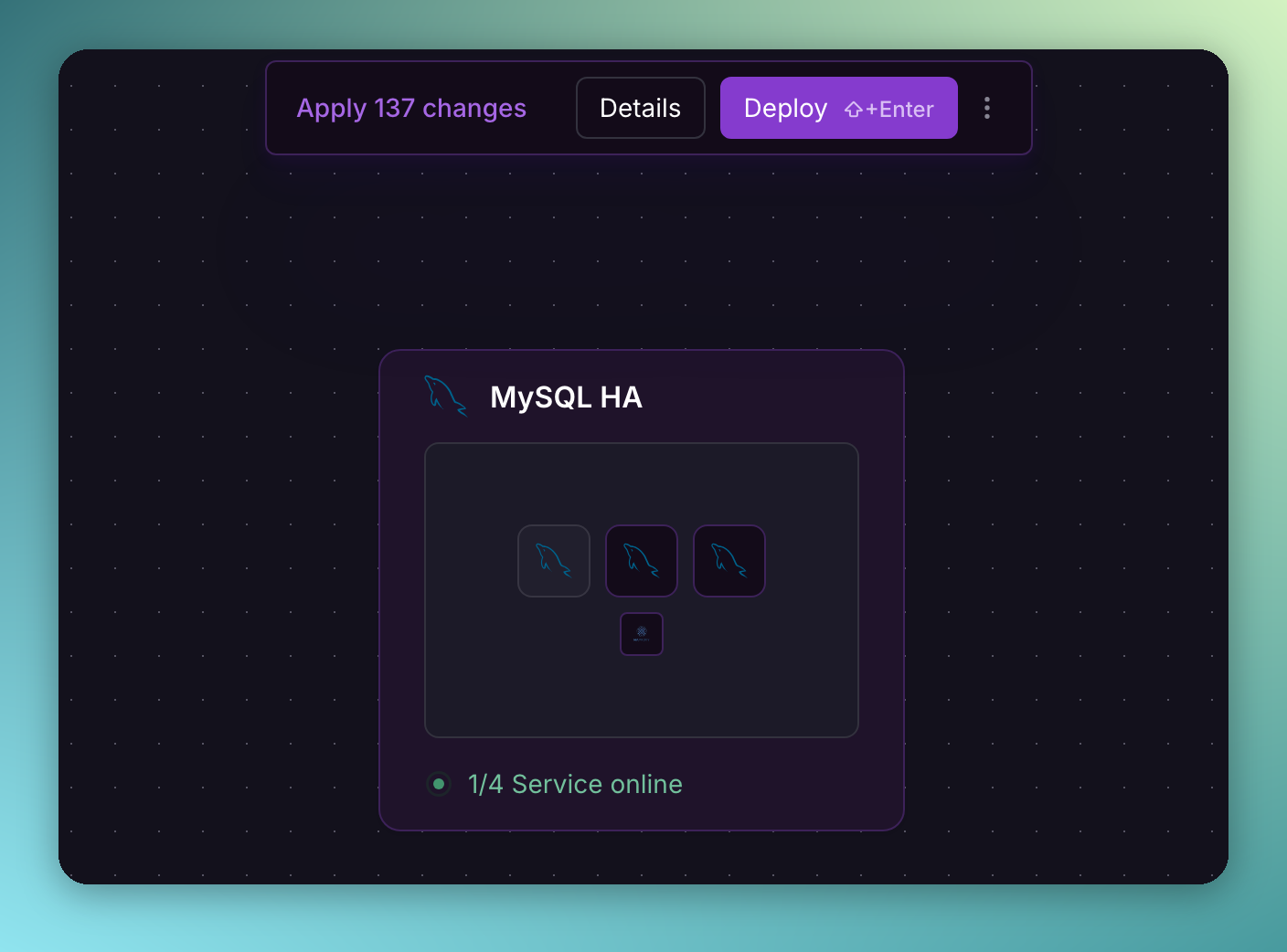
- Provision all cluster services (replicas and HAProxy) as staged changes
- Redirect you to the cluster overview
Review the staged changes and click Deploy to complete the conversion. The conversion adopts your existing volume and its data — the replicas clone from your original node when they first join the group.
Step 3 — Connection Strings
Once the cluster is deployed, connect through HAProxy — never to an individual MySQL node. HAProxy always routes to the current primary, so connections keep working across failovers:
| Variable | Points to | Use for |
|---|---|---|
MYSQL_URL | MySQL HA (HAProxy) — private network | Connections from inside Railway |
MYSQL_PUBLIC_URL | MySQL HA (HAProxy) — TCP proxy | Connections from outside Railway |
The HAProxy service also exposes the individual MYSQLHOST, MYSQLPORT, MYSQLUSER, MYSQLPASSWORD, and MYSQLDATABASE variables for clients that take connection details separately.
Railway automatically migrates all variable references within your project as part of the staged changes. Any service that references your MySQL service's variables (e.g. MYSQL_URL) will be updated to reference the new MySQL HA (HAProxy) service instead — no manual changes needed for services within Railway.
The only case that requires manual action is if you have hardcoded connection strings anywhere — in application code, Railway variables set to a literal URL (rather than a reference), other Railway projects, external tools, or CI pipelines. After deploying the cluster, update those to use the connection details from the MySQL HA service.
MYSQL_PUBLIC_URL exists only while public access is enabled. If your standalone MySQL was publicly exposed, the conversion carries the public endpoint over to MySQL HA automatically; otherwise the cluster is private by default — click Connect on the cluster view and add Public Access to create the TCP Proxy and the variable.
Step 4 — Verify Cluster Health
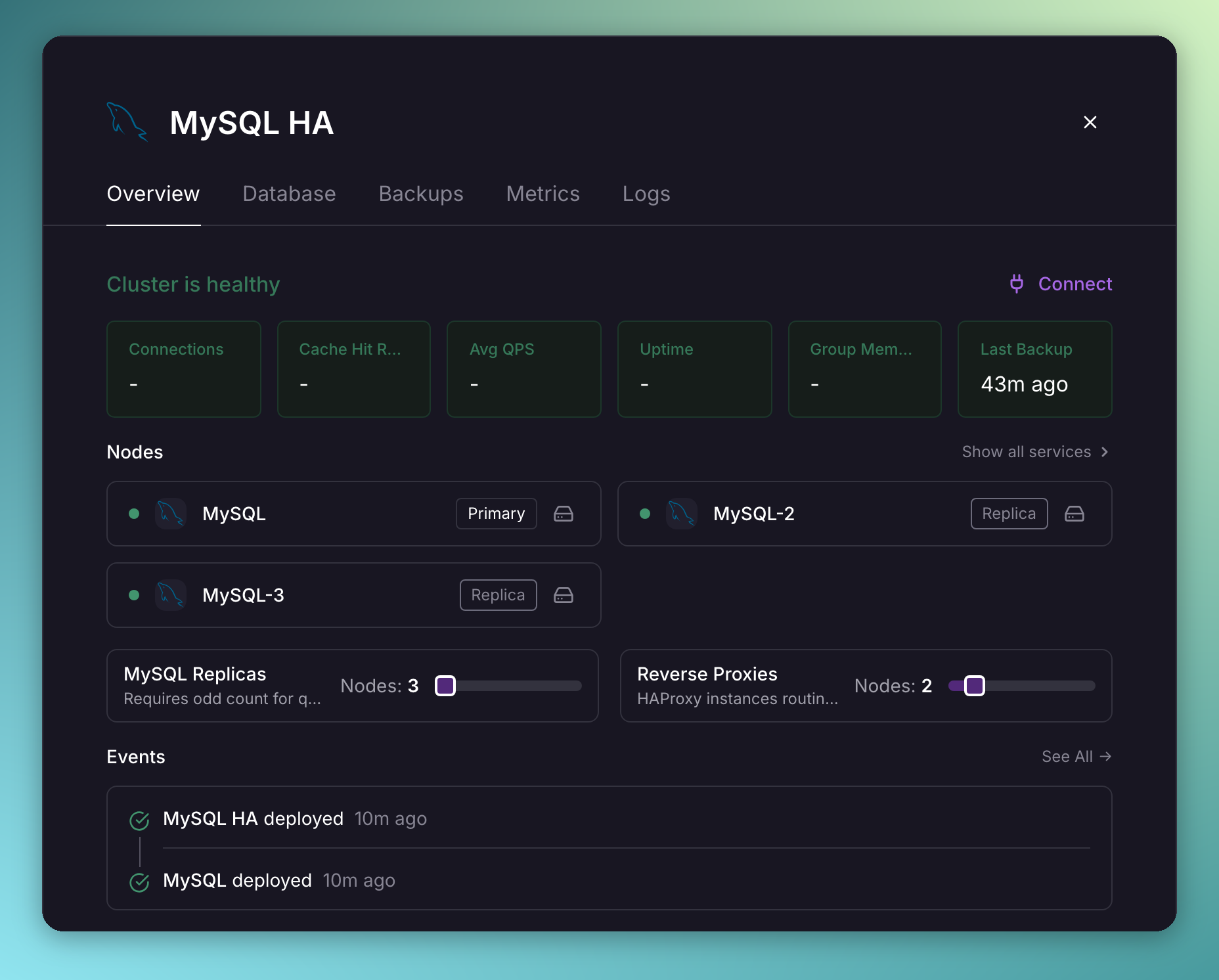
After all deployments reach a running state, allow a minute or two for the group to form and for the replicas to complete their initial clone from your original node. The cluster overview in the Railway dashboard shows each node's role — the current primary carries a Primary badge — along with per-node health.
Failover
Failover is automatic. When the primary becomes unreachable, the remaining members vote — once a majority agrees it is down, the group elects a new primary and HAProxy reroutes connections to it within one probe interval. In-flight connections to the old primary are dropped; clients that reconnect resume against the new primary without any configuration change, because they connect through HAProxy. When the old primary comes back, it rejoins the group as a secondary and catches up automatically.
To move the primary role back onto your original node deliberately (for example, after a failover, or before reverting), open the cluster overview and use Make Leader. This performs a coordinated switchover with the same brief connection drop as a failover.
Scaling the Cluster
You can change the number of replicas after conversion from the cluster overview. Replica counts move in steps of two (2, 4, 6, or 8) for the same quorum reason as at conversion time: the cluster total stays odd.
Backups and Restore
Each data node's volume carries the same backup schedules your standalone service had. Restoring a backup from the cluster view restores the same snapshot to every data node — the group reforms from the restored data with each node minting a fresh identity, so the restore never collides with the group's previous membership records.
The cluster also supports Point-in-Time Recovery: enabling it from the cluster's Backups tab rolls the archive contract through the members (replicas first, then a switchover, then the former primary), the current primary archives binlogs continuously, and a restore forks a standalone MySQL at the chosen moment — stitching the members' histories together across any primary handoffs.
Reverting to Standalone
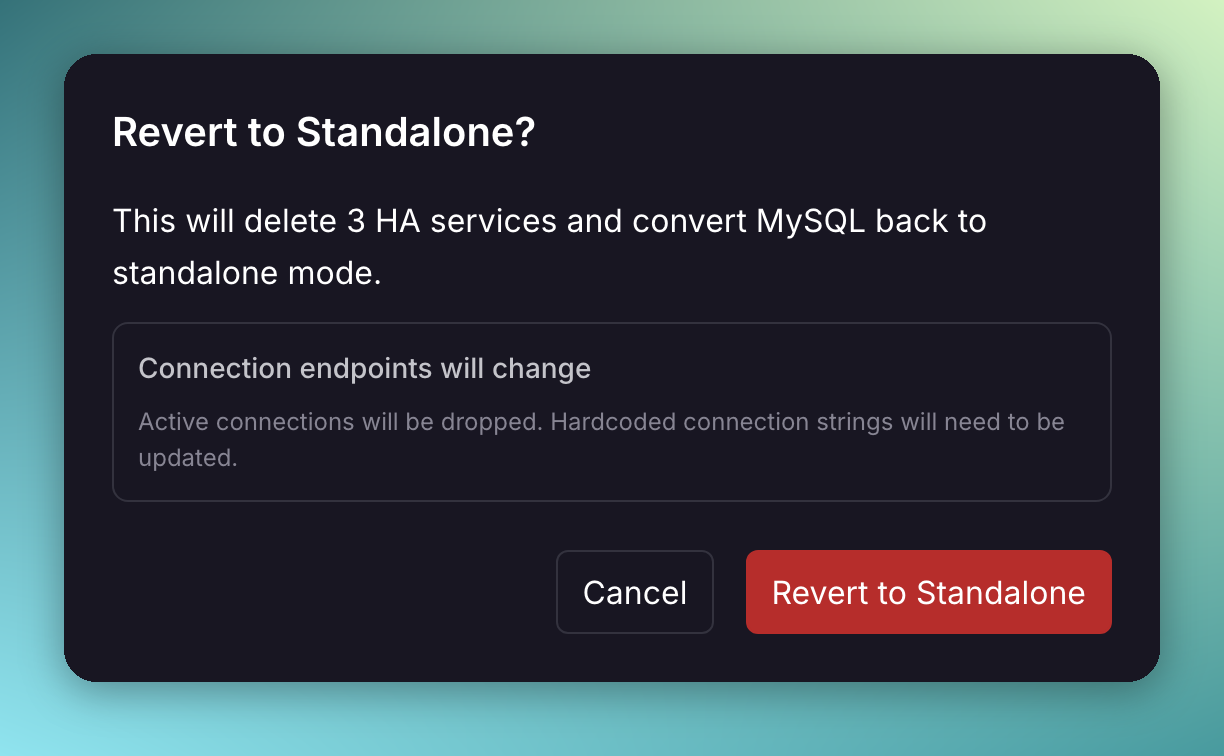
You can revert a cluster back to a single standalone MySQL service from the cluster overview, or from Database → Config → High Availability. Click Revert to Standalone to stage the changes.
Reverting will:
- Delete all HA services (replicas and HAProxy)
- Restore the TCP Proxy directly on the original MySQL service, if the cluster was publicly exposed
- Migrate variable references back to the root service
The reverted service keeps the cluster image (mysql-ha/mysql), which detects that it has no cluster peers and runs plain standalone mysqld with authentication intact. Don't swap the image back to a bare mysql tag by hand — the cluster image runs standalone perfectly well, and it is what keeps a later re-conversion possible without another image change.
Reverting keeps every deleted node's volume. Deleting the cluster services does not delete their volumes: the replicas' volumes stay in your project, unattached, and continue to count toward storage billing. This is deliberate — a revert never destroys data. Once you've confirmed the standalone MySQL service is healthy, it is safe to delete the leftover volumes from the project canvas. If you convert to HA again later, the new cluster provisions fresh volumes (with suffixed names, since the kept ones still hold the original names) — it does not reuse them.
Reverting is only available while the original MySQL service is the cluster primary. Reverting keeps that service and deletes every other node — if the primary role has moved after a failover, reverting would delete the node holding the latest data. If the original service is not the primary, use Make Leader to promote it first; the revert flow offers this when it applies.
Railway will automatically migrate all variable references within your project back to the original MySQL service as part of the staged revert. As with conversion, any hardcoded connection strings outside of Railway will need to be updated manually.
Support scope
Changing the template as shipped, such as its image, start command or variables, or changing the cluster's members outside Railway's high availability flows, makes the database yours to manage; see database support scope.